Bleeding Heart (pink or white flowers)
Perhaps one of the things I enjoy most about my yard is that it is a constantly changing environment. We have planted a variety of perennials that will bloom at various times throughout the growing season in order to maintain a fresh appearance. For instance, we have tulip bulbs growing under the
hydrangea. Long before any leaves pop out on the hydrangea bush, the tulips are in full regalia. By the time the tulip leaves are looking nasty, the hydrangea leaves are filling out. The
bleeding heart (dicentra) is planted between
tall phlox and
rudbeckia. Both those plants will take a long time to spread out and fill the void that is created when the early blooming dicentra fades.
Lily of the Valley
Another springtime favorite is the fragrant
lily of the valley. I love these prolific growers. I plant them under my lilacs and other shrubs. The leaves provide a nice ground cover when the flowers are gone. Yes, every few years I do have to dig up a clump or two that has started to head in a direction I don't want it to grow...but I always find someone who is happy to take them off my hands. These are great for woodland area's.
Lamium 'Orchid Frost'
Lamium 'Orchid Frost' is an amazing ground cover that is one of the first to bloom in early spring and one of the last blooms left in late fall. It likes to be ignored. I like a plant that doesn't beg for attention. It is simply happy sitting in the shade or part shade minding it's own business. It spreads nicely, but not voraciously. It fills in the voids left behind by spring blooming bulbs or the shady space under trees. In late summer it takes a breather from blooming and still looks great because of it's pale bluish green foliage. By the time cooler temps begin in early September it starts to bloom again till frost!
Impatiens, Begonia 'Escargot' and Lamium 'Orchid Frost' all grow nicely in shady spaces.
Tree frog on Daylily
Daylilies
When it comes to low maintance, Daylilies are tough to beat. They are incredibly durable and come in a vast array of colors. The only drawback is that once they are done blooming, they are not at all attractive. Therefore, I plant
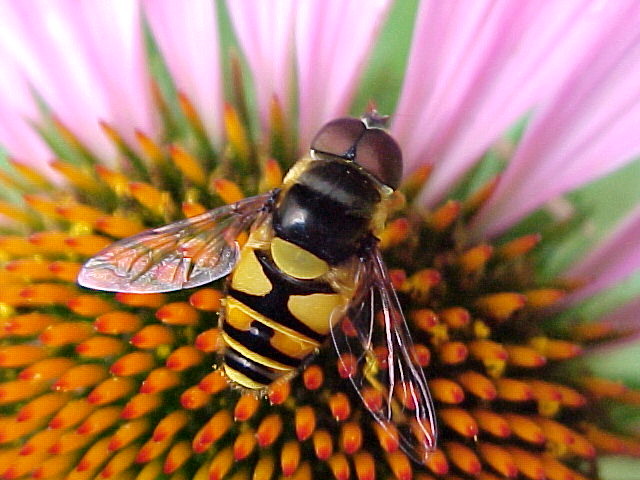
Coneflower and Rudbeckia between the daylilies to get continuous color all season long.
By the time the daylilies fade, long-blooming coneflower and Rudbeckia are just getting started!
Bee on Purple Coneflower
As you can see, I love taking pictures of our garden. Being able to see the beauty in every little aspect of nature is a gift I embrace with gratitude. Below, the image of the Chamomile reflected in the water droplets is like looking at the flowers through a magnifying glass. Chamomile is another prolific, low maintance plant that is also long blooming AND you can make tea with it! It does like to spread from seed so each year I will have to dig up the little clumps that are taking root outside the garden bed. I put them in small pots and give them away to my gardening buddies at work. It's a gift that keeps on giving.
Chamomile
Hosta
What can I say? It doesn't get any easier than Hosta. So many varieties to choose from! I throw in a few other leaf colors and styles (Japanese maple, astilbe, lilies) and WOW....all summer long. This part of the garden is a total no-brainer with the exception of putting crushed egg shells down in the crowns of the hosta in early spring. This is to keep the slugs at bay. Sad, but true....they crawl across the egg shells and it, well...let's just say those eggs shells are very sharp. If you didn't save your eggshells all winter, put it on the list for next year and buy some 'sluggeta' slug pellets to protect your hosta this summer. Slugs eat holes in hosta so if your hosta leaves look like they went through a hail storm, you've got slugs.
Hydrangea
By the time summer comes to an end I am savoring every moment in the garden. Mentally preparing for the long, cold winter is easier when I recall how pretty the faded hydrangea looks against the stark winter background. But, before those days come along, I get to watch my favorite Hydrangea 'Limelight' change from lime green to white to lime green with a rosy glow. I will cut some of the super long stems and bring them in the house to dry. The rest will stay on the shrub to remind me all winter long of summer days and nights in the garden.
All photos were taken by The Skillful Bee in her backyard.